

“The Best Exhibition I Have Ever Seen”
The impacts of war are global, timeless and long lasting. For millions of war survivors, the long-term social and physical legacies war creates will only begin once the conflict itself has ended.
Recovering The Past is a ground-breaking conceptual exhibition in which I develop a unique narrative to explore the impact of the legacies of war on societies.
Moving away from convention, Recovering The Past is most emphatically not an exhibition of war itself, but rather of people impacted by it. By laying bare the long-term social and physical consequences of human conflict, my aim is to provoke reflection on the past, present and importantly, the future.
This is an exhibition with a message to our future selves. With human-conflict an ever-present reality, the stories that Recovering The Past tells are not historical relics, but sobering templates of all wars to come.
The Forgotten Many
War’s dead are rightly commemorated, but is it right that its survivors are rarely acknowledged? Recovering the Past addresses that imbalance and extends the victim status beyond those who are killed in a war, to those who are injured or bereaved by it.
For every person killed in war, another will grieve that loss. Survivors of war will often endure a lifetime of mental-health issues, while the families of injured combatants will become their unwitting carers. Recovering The Past asserts that all of these people are victims of war, yet there are no memorials to acknowledge their suffering, their plight has been all but forgotten.
In 1940, more than twenty years after her husband returned from The Great War, Violet Aiken said:
“My husband [was] a long sufferer from his war injuries…& was nursed…day and night in our own little home here by myself.”
Violet, and the many women like her need due recognition. In attributing victim status to every person impacted by war, Recovering The Past eliminates gender imbalance that has dominated past conflict commemorations.
An Exhibition is Born
Recovering The Past stands unique in its representation of the sufferers of war.
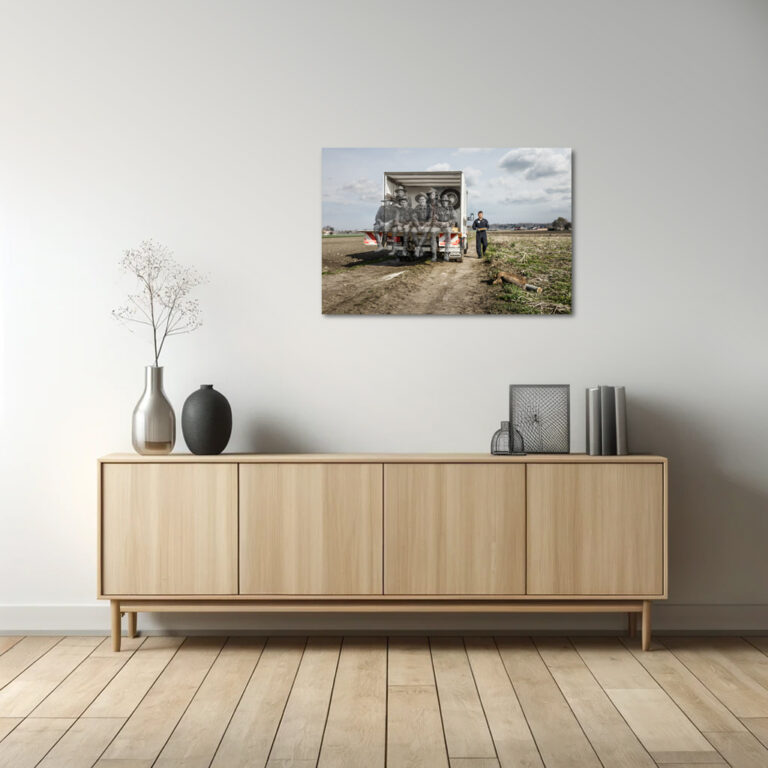
This innovative exhibition simultaneously employs twenty-five, striking montage images and historic personal memoirs to convey a troubling story.
From the enlistment into the army of a young and proud Australian man, the exhibition’s text takes its viewer on through the psychological impact inflicted by battle and ultimately into the post-war world, where the war’s long-term legacy on its survivors and their dependents is laid bare. Told in their own words, Recovering The Past is a thought-provoking chronological journey through time.
This exhibition’s imagery brings to the viewer’s attention a physical legacy of all conflicts, that of unexploded ammunition. Each photomontage was produced in full co-operation with the Belgian armed forces, for whom the ongoing recovery of unexploded First World War shells from the former battlefields of Flanders is a daily reality.
Taking a novel approach to explore the less-appreciated societal impacts of war, this multi-layered exhibition combines my own photographs taken on location in Flanders, with archival imagery and poignant historic memoirs.
Recovering The Past has an impressive history of international public display, with over 182,000 visitors to date. First displayed at the United Nations, Geneva in 2015, this exhibition later featured as a component of Belgium’s centenary commemorations of the Great War. Since, and over a period of seven years, it has been on a continuous, twenty-one gallery tour of Australia, including a six month display at Melbourne’s nationally significant Shrine of Remembrance.
A compelling, visual exploration of post-conflict achievement and reconciliation, Recovering The Past brings the past and present together through a series of striking montage images.
The Great War: the foundation of the project
Recovering The Past is based on the experience of The Great War. A catastrophic human tragedy of the early 20th century, the war brought an industrial scale of armament manufacturing to the field of human conflict. Over 10 million service personnel died in the Great War, more than 50 million survived it; estimates suggest that 20-25% of all ammunition fired during the four years of the war’s duration did not explode. The long-term legacies of its traumatised survivors and vast quantities of unexploded ammunition provide the basis for this work.
The immense suffering of those whose voices from the past appear in the exhibition text, present a sobering testimony, yet in reality, their words are forever prescient. Recovering The Past raises the profile of these people, and by giving them a long overdue and much deserved voice, I make them ambassadors to our future.
In 1974 – more than fifty years after the Armistice – Australian First World War veteran Jim McPhee said:
“We thought we managed alright, kept the awful things out of our minds, but now I’m an old man they come out from where I hid them. Every night.”
McPhee was far from alone, he was one of many millions of the war’s survivors who were to endure a lifetime of Post Traumatic Stress Disorder. The Great War took a terrible toll on societies in the post-war world, its legacies were to impact people from nations the world over. Yet those same legacies are true of every war, and are universal across national boundaries, cultures, religions and political systems.
Amputee servicemen of the Great War. Largely forgotten, there is no dedicated memorial to war’s survivors.
DOVO-SEDEE: responding to a physical legacy of war
Recovering The Past was produced through an unprecedented collaboration of myself and DOVO-SEDEE, the Belgian Army bomb-disposal team. Now in their second century of continuous operations in Flanders, for the personnel of this specialist military unit, their work will take many more years to complete.
“I make several hundred collections of shells from the Flanders region each year…”
Sobering words aren’t they; spoken by a serving member of the Belgian Army’s bomb-disposal team, he is just one of many personnel who have served in this unit since its creation in 1920, and one of the many thousands of men and women of similar teams which now operate across the world on a daily basis.
Unexploded munitions from past conflicts will collectively total in the hundreds of millions. This long-term physical consequence of war continues to claim innocent victims every year. The humanitarian mission carried out by bomb-disposal engineers is essential, but despite the obvious dangers, it is also largely unseen. Recovering The Past is proud to raise the profile of their work.
A DOVO-SEDEE team recover a hoard of 148 unfired shells from a field in West Flanders.
Limited edition prints
Limited-edition, archival-quality prints from this exhibition are available for purchase in three distinct sizes. Each print will feature the image name, its unique edition number and the artist’s signature.
Ian Alderman, Artist, and creator of Recovering The Past
Pointing To A Likely Future
A photograph is a record of a past event. Recovering The Past deliberately challenges this convention in pointing its viewer firmly towards the future.
Weaving two parallel narratives, the exhibition’s imagery take the viewer on a pictorial journey through the complex and high-risk operation to recover and destroy century-old, unexploded ammunition from the former battlefields of Flanders. Simultaneously, the imagery compresses a century of intervening time by juxtaposing members of the bomb disposal team with historic images of Australian soldiers who served in Flanders during the Great War. The artworks present a compelling, image of post-conflict and achievement and reconciliation. Do the images also reveal a team effort across time? That’s for you, the viewer, to decide.
The project does not feature scenes of war; this is not a project about a war itself, but one of people impacted by it. This is a story about the silent majority a war leaves behind. It’s a story relevant to everyone, and everyone needs to engage with it.
This Exhibition Matters
This exhibition is so much more than just a series of photographs and text. It exists to challenge the viewer into engaging with the complex, less-appreciated legacies of war. The mental-health issues revealed through the poignant memoirs of the men and women in the exhibition’s text panels are from a century ago; today, societies the world-over are confronted with significant mental-health challenges, this exhibition plays an important role in raising the profile of this debilitating illness.
“The most harrowing, touching explanation of what war does that I think I’ve ever viewed. It brought tears to my eyes & shivers down my spine. Just fantastic.”
Unexploded ammunition and conflict-induced human trauma are universal legacies of all wars. Hundreds of wars have been fought since the Armistice of 1918, each creating comparable legacies for successive generations to deal with. This is true of all wars since, those of this moment, and those yet to come.
For as long as war exists, the message conveyed in Recovering The Past will remain forever relevant.
Despite the intervening century of time between the depicted men, all are treated as equals. Here, equality is evident through the mirroring of a simple administrative task.
History
Exhibited at twenty-seven venues across four nations, and viewed by more than 180,000 people, Recovering The Past’s narrative is one of timeless significance.
Mission
With its narrative of global relevance, artist Ian Alderman is striving to bring this human-focused exhibition to ever more international audiences.
Vision
That this exhibition will contribute to our broader understanding of the impacts of war in a post-conflict world.